Benchmark of quantum algorithms for ground state preparation in the presence of noise
Three families of ground-state-preparation algorithms — adiabatic, multi-frequency cooling, and QAOA — are put on a single solvable footing. The result is a controlled comparison that says where each one wins, where it breaks, and how noise reshapes the trade.
Paper: arXiv:2606.20551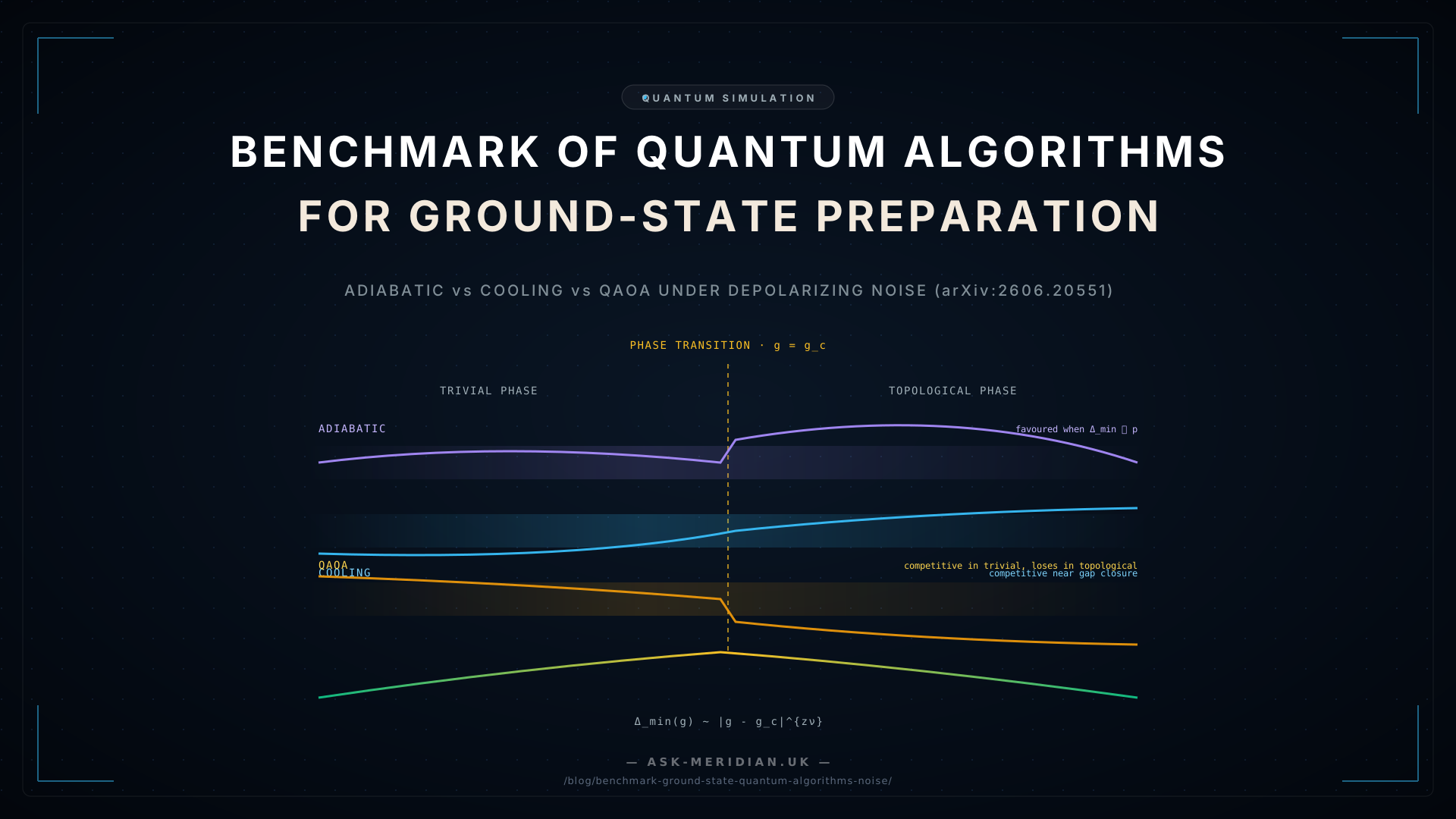
arXiv:2606.20551 is not a new algorithm paper. It is a benchmark paper, and the framing matters. Molpeceres, Lu, Cirac & Kraus take a single exactly-solvable family of quadratic fermionic Hamiltonians, instrument it with depolarizing noise, and ask the question that any practical ground-state-preparation team has to answer eventually: given a fixed noise budget, which algorithm wins — and where?
The model has two phases separated by a quantum phase transition, which is the entire point of the choice. The two phases stress the algorithms in different ways: in the trivial phase the spectral gap stays open, and slow protocols have time to work; in the topological phase the gap closes, and that is where the protocol choice has to change. The same Hamiltonian, the same noise channel, the same metric — only the operating point moves.
The headline result is that no single algorithm wins everywhere. Adiabatic evolution is favorable in the trivial phase, where it can out-perform both cooling and QAOA on relative-energy error. A multi-frequency cooling algorithm becomes competitive or superior in the topological phase, where the gap closes and adiabaticity breaks down. QAOA sits between them — competitive with cooling in the trivial phase, typically outperformed in the topological regime.
The model and the metric
The Hamiltonian family is quadratic in fermionic operators, parametrized by a coupling \(g\) that drives the system across a phase transition:
The exact solvability of the model is what makes the benchmark clean: the ground state and the gap are known in closed form, so the achievable relative energy \(\varepsilon_{\text{rel}} = |E - E_0| / |E_0|\) is a closed expression in the noise rate, the protocol depth, and the gap. No numerics are required to anchor the scaling — the simulations only validate the closed form and the regime boundaries.
The depolarizing channel acts on every qubit after every layer with rate \(p\). That choice is the worst-case asymmetric noise model: it does not preserve any symmetry the Hamiltonian has, which is why the analytical scaling of \(\varepsilon_{\text{rel}}\) versus \(p\) and the protocol parameters is the cleanest version of the comparison.
How the three algorithms stack up
The three families are not adversaries in the same sense. They make different bets about what the bottleneck is, and the paper makes those bets explicit:
- Adiabatic evolution trusts the gap. When the gap is open, you can change the Hamiltonian slowly enough that the system tracks the instantaneous ground state. The cost is time: total evolution time scales as \(1/\Delta_{\min}^2\) in the worst case, and in the topological phase \(\Delta_{\min}\) closes. That is the loss mechanism.
- Multi-frequency cooling is dissipative by design. It uses engineered Lindblad operators that target the relevant low-energy subspace and bleed excitations out at controlled rates. In the topological phase it pays off because it does not need a finite gap — it just needs the dissipative gap.
- QAOA is a variational ansatz with discrete layers. Its competitive region is bounded by the ansatz depth; the paper shows where the achievable \(\varepsilon_{\text{rel}}\) curve crosses the cooling curve as a function of \(p\) and depth, and that crossing moves into the trivial-phase region as the topological gap closes.
The numerical simulations confirm the analytical scaling and pin down the crossover. The figure that earns its keep is the phase diagram: relative-energy contours in the \((g, p)\) plane, with the algorithm that wins each cell annotated. That diagram is the kind of artifact that turns a benchmark into a decision tool.
Noise robustness, not just noise scaling
Most noise benchmarks stop at "how does the error grow with rate". This one goes further and asks: how robust is the protocol to parameter imperfections — miscalibrated drive amplitudes, off-resonant drives, imperfect timing? The answer matters because in practice the protocol error floor is set by control imperfections, not the depolarizing channel.
The first term is the noise floor: linear in the depolarizing rate \(p\) and the protocol depth or time \(T\). The second term is the algorithmic floor: adiabatic or cooling-limited, decaying with the square of the gap. The crossover where the noise floor equals the algorithmic floor is the operating point that determines the minimum \(\varepsilon_{\text{rel}}\) the benchmark can ever resolve.
For cooling, the parameter-robustness margin is wider than for adiabatic or QAOA. In other words: when the calibration of the cooling rates drifts, the protocol degrades gracefully. The same drift on an adiabatic schedule or on QAOA angles pushes you out of the operational envelope much faster.
What I'd keep in mind
There are three numbers worth carrying forward from this paper:
- The gap-closing exponent that sets the adiabatic break-even: \(\Delta_{\min}(g) \sim |g - g_c|^{z\nu}\). Once you know \(z\nu\) for your model, you know the protocol time you need, and you know when adiabatic is no longer competitive.
- The noise-rate scaling \(\varepsilon_{\text{rel}} \propto p\) at fixed protocol depth. Linear is good news: it means the noise channel can be characterized once, and the achievable floor extrapolates without re-running the full benchmark.
- The parameter-robustness margin of the cooling protocol. This is the number that decides whether a benchmark winner is actually deployable on hardware that drifts.
What I'd not carry forward: the specific algorithm choice for any particular \((g, p)\) cell. The cells will move the moment you swap the Hamiltonian family, the noise model, or the protocol depth. The framework is the durable artifact.
Takeaway
Benchmarks with closed-form scalings and an explicit phase diagram are what move ground-state-preparation from algorithm-of-the-month to engineering. This paper is less about cooling beating adiabatic and more about putting all three contenders on the same solvable footing, with a metric that closes analytically and a parameter-robustness test that closes the door on over-tuned wins.
That is the standard to hold new ground-state-prep protocols to: not a single-cell win, but a cell-by-cell map and a robustness number. Once that template is in place, every future claim is forced to be either an extension of the diagram or an honest retreat.