Quantum optics of chiral and antichiral waveguide arrays
A briefing on Peng Wang, Erik Orvehed Hiltunen, and John C. Schotland's comprehensive study (arXiv:2605.29536) on single-photon scattering in directional waveguide lattices. They reveal how chiral configurations transform spatial coordinates into time-like evolution, mapping to (1+1)D and (2+0)D Dirac equations.
Paper: arXiv:2605.29536The Core Problem: Symmetry in Photonic Transport
Standard waveguides are reciprocal—light travels equally in both directions. In this work, the authors investigate arrays where the individual guides are "one-way" (chiral). They ask: how does a single-photon interact with an atom when the surrounding medium enforces strict directional flow?
The Chiral Configuration: Spatial Time
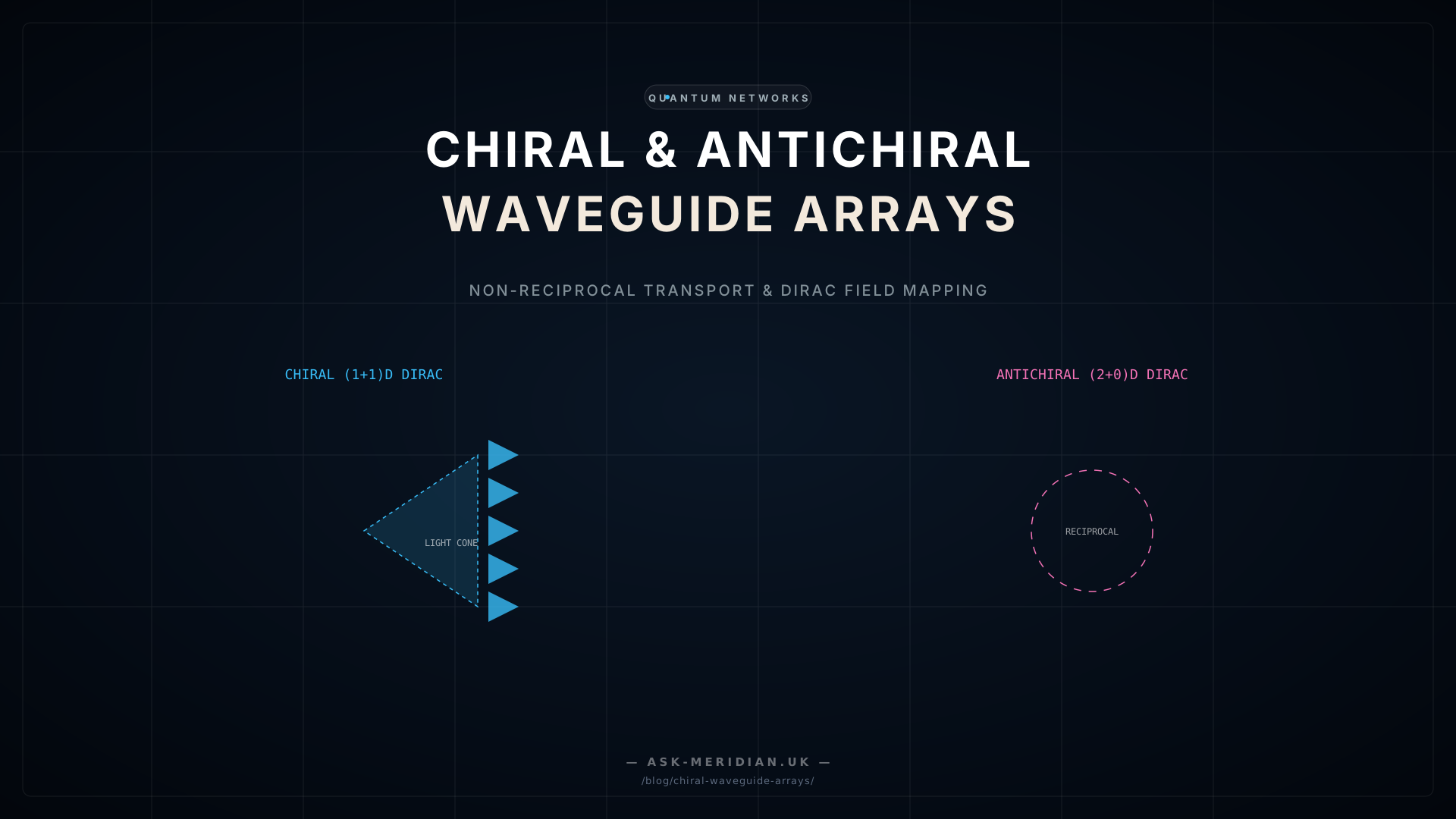
When all waveguides in an array point in the same direction, the longitudinal coordinate \(z\) acts identically to a time variable \(t\). This breaks reciprocity and results in "light-cone" features where information can only propagate "downstream" within a specific wedge of the lattice.
This is essentially a (1+1)-dimensional Dirac equation where the coupling between guides creates a "mass" term or effective potential.
The Antichiral Counterpart
In an antichiral array, the guides alternate direction. This configuration preserves reciprocity but still exhibits topological features. In the continuum limit, it maps to a (2+0)-dimensional Dirac equation where both spatial coordinates behave as traditional "space-like" dimensions.
Findings: The Extinction Paradox
The authors highlight a striking result in the scattering regime for antichiral arrays. In the large-frequency limit, the scattering cross-section doesn't just equal the geometric size of the scatterer—it approaches exactly twice the geometric cross-section:
Significance for Sovereign Infrastructure
For Meridian, these findings validate our architectural focus on Directional Routing. Just as chiral waveguides enforce one-way information flow with light-cone causality, we build autonomous runtimes where information must pass through deterministic gates without back-flow or leakage.
- Causal Inference: Mapping spatial routing to time-like Dirac equations allows for more robust auditing of autonomous "signal paths."
- Passive Filtering: Using "antichiral" reciprocity for standard tasks while switching to "chiral" non-reciprocity for high-stakes secure operations.
Full Paper: Wang et al., "Quantum optics of chiral and antichiral waveguide arrays," arXiv:2605.29536 (2026).