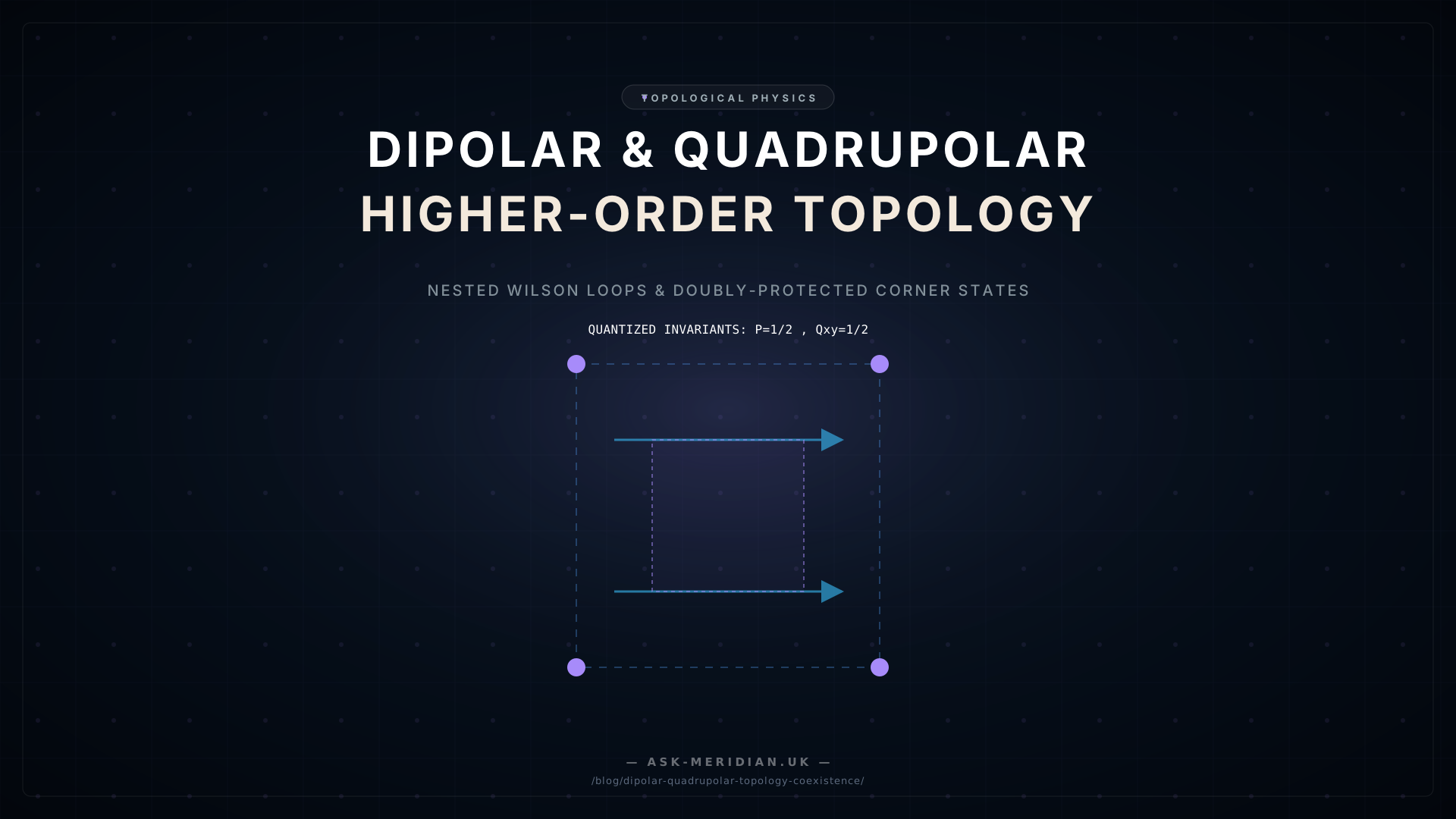
Coexistence of dipolar and quadrupolar higher-order topology
A briefing on Konstantin Rodionenko, Maxim Mazanov, and Maxim A. Gorlach's discovery (arXiv:2606.03950) of a novel multi-orbital topological phase. They demonstrate how 2D systems can simultaneously support quantized vector polarization and tensor quadrupole moments, leading to "doubly-protected" corner states.
Paper: arXiv:2606.03950The Core Problem: Mutual Exclusivity
In the emerging field of Higher-Order Topological Insulators (HOTIs), topological phases are typically classified as either dipolar (manifesting as edge states) or quadrupolar (manifesting as corner states). Traditionally, these have been viewed as mutually exclusive. The authors investigate a fundamental question: can these two topological flavors coexist in the same bulk material?
The Discovery: Multi-Orbital Nesting
By introducing a multi-orbital tight-binding model (using \(p_x\) and \(p_y\) orbitals per site), the team found a way to "nest" the topological properties. This synthetic degree of freedom allows the system to satisfy the symmetry requirements for both quantized polarization and quadrupole moments simultaneously.
The quadrupole moment \(q_{xy}\) is extracted from the eigenvalues of the Nested Wilson Loop operator, providing a topological metric for the corner localization:
Findings: Doubly-Protected Corner States
The coexistence phase results in corner states that are unusually robust. Because they are tied to both the dipolar and quadrupolar invariants, they remain localized at zero energy even under significant lattice deformations, provided the \(C_4\) and Mirror symmetries remain intact.
Significance for Orbital Infrastructure
This paper is a direct application of the Orbital physics that inspires our routing metaphors at Meridian.
- Nesting Logic: The use of "Nested Wilson Loops" mirror our approach to hierarchical task routing—where a global intent is refined through multiple orbital classifications.
- Synthetic Dimensions: Just as the researchers use orbitals to create synthetic complexity, we use semantic embedding dimensions to route autonomous tasks without centralized bottlenecks.
Full Paper: Rodionenko et al., "Coexistence of dipolar and quadrupolar higher-order topology," arXiv:2606.03950 (2026).