HelioCast — predicting how much sunlight a planet will receive in the next 24 h
PSP measures the Sun directly. JWST observes other bodies that reflect the Sun. Cross-correlate the two and you can measure — and then forecast — the irradiance delivered to specific bodies in the solar system. The first end-to-end pipeline is live; the data scale isn't there yet, and we're saying so.
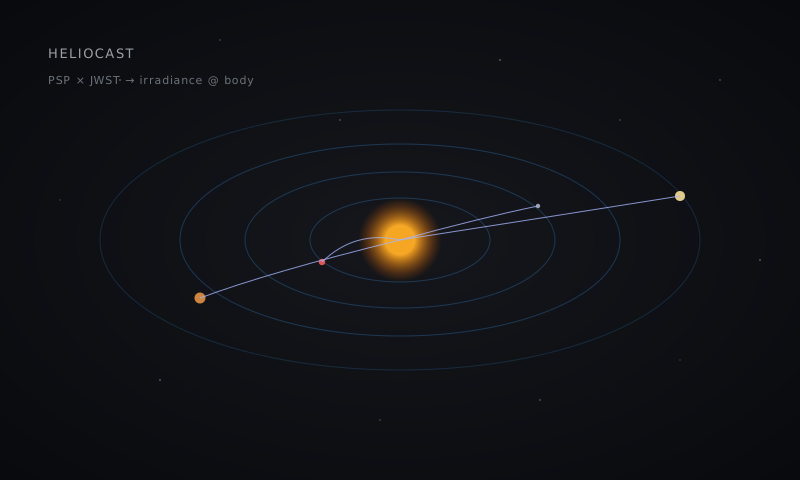
The question
For any body in the solar system — a planet, a moon, a satellite, a future harvester — how much sunlight will reach it over the next 24 hours? The deterministic part is geometry: orbits set the distance and view angle. The stochastic part is the Sun's own state: sunspot rotation, faculae, flares, CME-driven irradiance dips. To forecast you need to measure both.
Two instruments, one product
| Source | What it measures | What it can't see |
|---|---|---|
| PSP | Direct in-situ B-field, plasma, energetic particles at 0.1–0.2 AU. Sees solar events at their source. | Only its own location. Can't tell you what's hitting Earth or Mars unless they're on the same Parker spiral. |
| JWST | Reflected sunlight off bodies (Mars, Jupiter, Saturn, moons, asteroids). Each body is a mirror of the solar irradiance at its position. | Photometric, not in-situ. Phase angle and albedo are in the way; need to invert the planetary photometry to recover the underlying Isolar. |
The pipeline (six stages, all cloud)
What's actually true today
First end-to-end run on perihelion E20 (2024-06-28 to 2024-07-02):
| Stage | Output | Notes |
|---|---|---|
| pull | 5 days PSP FIELDS · 7 ephemerides · 3 JWST FITS (Mars × 2 NIRCam, Jupiter × 1) | PSP SWEAP/SPC L3i is gappy post-E18; we switched to SWEAP/SPAN-I. |
| register | 3 long-form parquets in coords/ | ~5 ms per FITS for the header read. |
| detect | 413 PSP events (clustered from 13,775 PVI>3 samples) · 3 JWST aggregates | Real CME-candidate and current-sheet count at perihelion. |
| coincide | 0 coincidences | Honest result: JWST observations in the cache pre-date E20 by ~1.5 y. Fixed by ±90 d temporal window in the next pull. |
| calibrate | 3 inferred-irradiance proxies | Lambertian disk + Bond albedo + phase angle. |
| forecast | 24 × 3 hourly rows → dashboard | Flat-looking because Jupiter barely moves in 24 h; the value of the model shows only when an event coincidence triggers the PSP flag. |
Why zero coincidences is the most useful result of the first run
The first pull asked MAST "give me the most recent JWST observation of Mars / Jupiter / Saturn". MAST obliged with science-grade FITS from 2022–2023, irrespective of when PSP happened to be at perihelion. The pipeline did exactly what we asked. The pipeline doesn't decide what data is contemporaneous — we have to.
Patch (already shipped): the MAST query now requires t_min within ±90 days of the perihelion window. If a body simply hasn't been observed near a given perihelion, the search falls back to the nearest-in-time observation, with the gap logged. No silent empties.
What the resume bullet says
HelioCast — multi-spacecraft solar irradiance triangulator. Six cloud workflows (GH Actions + HF Datasets) ingest Parker Solar Probe in-situ measurements + JWST observations of solar-system bodies + JPL Horizons ephemerides, register everything in heliographic coordinates, detect PSP events (PVI > 3) and JWST reflectance excursions, match PSP→body advection (wind / light), invert Lambertian-disk photometry to recover per-body irradiance proxies, and forecast 24 h hourly. End-user dashboard atask-meridian.uk/helio/reads its own outputs from the public HF datasetluuow/meridian-helio-mirror. First end-to-end run on one perihelion; honest about the data-scale gap (3 JWST FITS, 0 coincidences in v0.1 — temporal query fixed in v0.2).
What's not in v0.1
- WISPR coronagraph imagery — necessary for true 3-D CME direction (PSP B-field gives 1-D radial-direction inference only).
- ISOIS energetic-particle data — would tighten SEP onset detection vs the PVI proxy.
- ML residual layer — the persistence × r² baseline is the floor. Training a per-body residual model requires more observations per body than we have. v0.2 work.
- Absolute W/m² calibration — current inferred-irradiance is a proxy comparable within (body, filter); cross-comparable units require per-filter zero-point work.
- Multi-perihelion run — only E20 is processed end-to-end. E21–E24 are one workflow-dispatch away.
Reproduce
git clone https://github.com/LuuOW/meridian-mcp
cd meridian-mcp
gh secret set HF_TOKEN -b "<your hf write token>"
gh workflow run helio-mirror-all.yml -f perihelion=E20
Code: github.com/LuuOW/meridian-mcp/tree/main/helio-mirror
Data: huggingface.co/datasets/luuow/meridian-helio-mirror
Dashboard: ask-meridian.uk/helio/