Log-concavity and tunneling: adiabatic quantum optimization for convex functions (with a spike)
Tunneling is the supposed ace of adiabatic quantum optimization, but the evidence has lived in a single toy: the Hamming-weight-with-a-spike problem. A new paper by Braida, Bermot and Apers extends that analysis to a much wider family of potentials, anchored on a structural property the ground state turns out to share with convex cases.
Paper: arXiv:2606.23614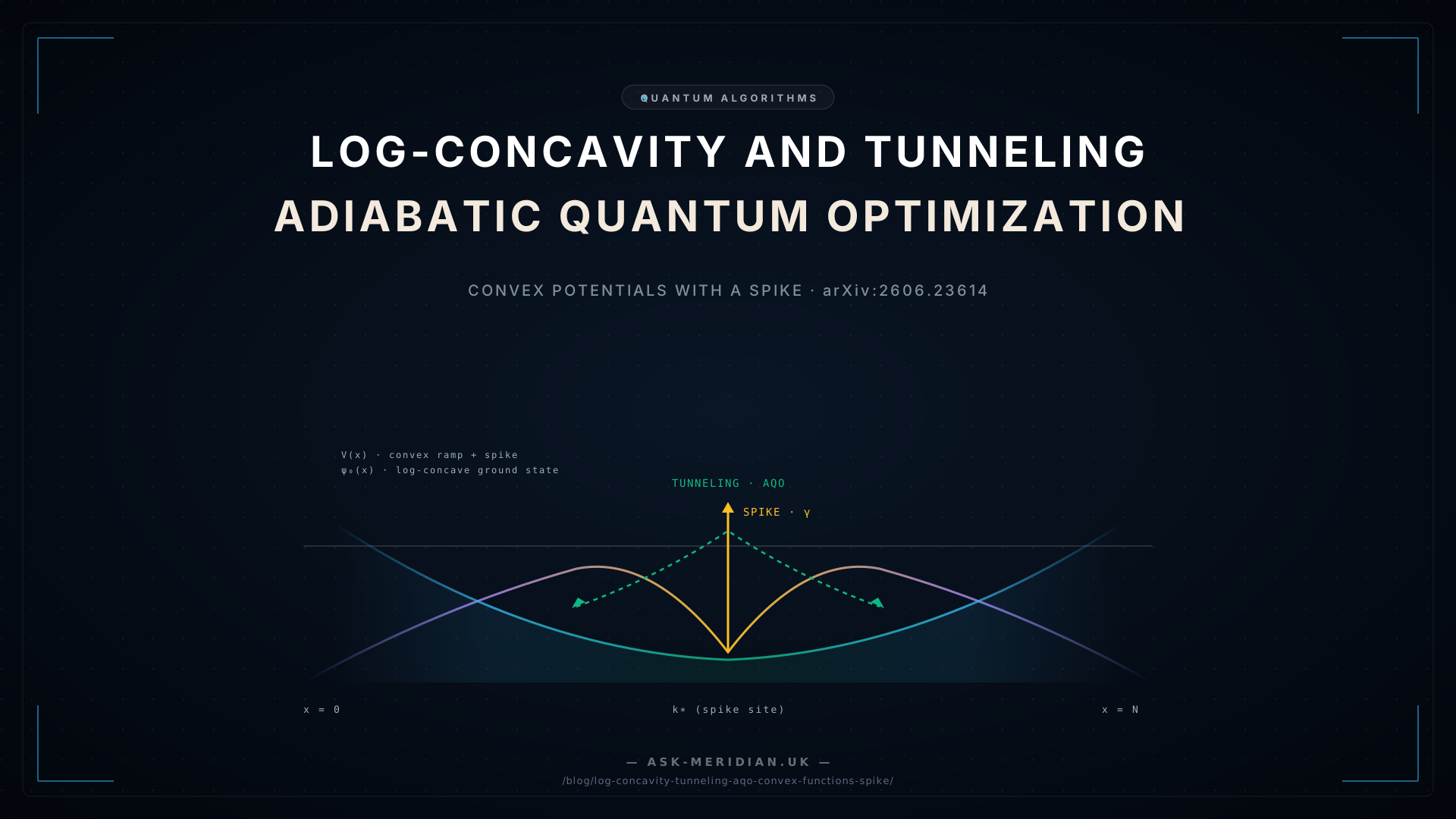
arXiv:2606.23614 takes a single observation — that the ground state of the Hamming-weight-with-a-spike Hamiltonian is log-concave — and asks how far that observation actually travels. Braida, Bermot & Apers turn it into a structural property of the ground state of a wide class of one-dimensional Schrödinger operators, and then use it to extend the perturbative tunneling analysis of the original HWS problem (Reichardt, ’04) to potentials that are not exactly solvable.
The upshot is a structural rather than a numerical claim: tunneling beats local search on a family of convex potentials with a single spike, not just on the linear spike toy. The analysis is discrete, one-dimensional, and clean — and it improves the spectral-gap bound of Jarret and Jordan (’14) along the way.
Why a single toy was the wrong unit
The HWS problem is the canonical “this is where AQO wins” example. The Hamiltonian is diagonal in the Hamming-weight basis with a linear ramp plus a single spike at a fixed Hamming weight, and the proof-of-concept story is that AQO crosses the spike faster than any local-search algorithm by tunneling through the Hamming barrier. Reichardt’s perturbative analysis pinned down the scaling.
But the result was load-bearing for a single potential shape. Every time someone wanted to extend it to a different convex-with-spike family, they had to redo the perturbative expansion from scratch. The new paper argues that log-concavity of the ground state is the right unit: it is the property that makes the perturbative expansion tractable, and it survives generalisation from linear ramps to arbitrary convex shapes (and beyond, to a meaningful family of non-convex shapes with local minima).
That is the move from one toy to a class of toys. Once the structural property is identified, the same machinery reaches further.
The structural property: log-concavity
For a discrete, one-dimensional Schrödinger operator on a finite or half-infinite chain, the ground state \(\psi_0\) is log-concave if
This is the discrete analogue of \(\psi'' \leq 0\) for a continuous ground state. The continuous analogue is a 1976 Brascamp–Lieb result that proves log-concavity of the ground state for convex potentials. Braida, Bermot & Apers produce a discrete version of that argument and show it covers the convex case plus a meaningful class of potentials with local minima.
Once the ground state is log-concave, the rest of the paper’s two contributions fall out:
- Spectral-gap lower bounds. Log-concavity gives a tighter control on the ground-state mass distribution. The new bounds strictly improve over the Jarret–Jordan (’14) convex-potential result.
- Perturbative HWS analysis. Reichardt’s expansion transfers to any potential in the log-concave-ground-state family. The concrete instantiation in the paper takes a quadratic potential (which is no longer exactly solvable) and shows the same AQO speedup.
From Hamming-weight-with-a-spike to convex-with-a-spike
The headline new example is the quadratic variant of HWS. The original analysis assumed a linear potential so that the off-spike part of the Hamiltonian was exactly solvable (free-fermion-like). The quadratic variant breaks that solvability, which is exactly the case where the old perturbative toolbox does not work out of the box.
The ground state is log-concave by the new theorem. The perturbative expansion goes through and gives an AQO runtime that scales polynomially in the inverse spike height, beating local search by a factor polynomial in the system size. The same scaling Reichardt obtained for the linear case.
What log-concavity actually buys
Log-concavity is not just a label. It is the property that turns a perturbative expansion of the ground-state mass around the spike into a controlled error term. Intuitively: if the ground state is log-concave, then the probability mass around the spike is well-approximated by a one-mode coherent excitation, and the second-order corrections are bounded by the curvature of the log-concave envelope.
Concretely, that means:
- The AQO speedup transfers to any potential whose ground state stays log-concave through the adiabatic sweep.
- The spectral-gap bound improves because log-concavity rules out the ground-state mass concentrating in two disjoint lumps (which would be the failure mode for the Jarret–Jordan bound).
- The class of eligible potentials is larger than convex — it includes some local-minimum potentials, which means the result is not a flat re-derivation of the Brascamp–Lieb continuous result.
The cost is that the structural property is non-trivial to check for a given potential. Log-concavity is not a closed-form condition; you prove it by a careful Schur-test or comparison argument, and the bookkeeping for non-convex potentials is delicate.
What I'd keep in mind
Three things to carry forward from this paper:
- Log-concavity is the unit. When you see a “AQO beats local search on X” claim, ask whether X has a log-concave ground state through the sweep. That is the testable structural property the new paper puts on the table.
- The spectral-gap improvement is strict. For convex potentials, the new bound dominates Jarret–Jordan (’14). Anywhere that bound was the bottleneck for a downstream runtime argument, the new paper buys you an improvement.
- The HWS program has a wider scope. Quadratic ramps are the immediate win, but the proof goes through for the entire log-concave-ground-state family. If you have a candidate AQO advantage problem on a non-linear potential, this paper is the place to start.
What I would not over-claim: AQO is now a general-purpose optimizer. The result is structural — it tells you when the HWS-style argument transfers — not universal. Convex-with-a-spike is a class, not all of optimization.
Takeaway
Braida, Bermot and Apers do not propose a new algorithm. They identify the structural property that makes the canonical AQO-tunneling argument work, prove it holds for a wider family than was previously known, and use it to extend Reichardt’s perturbative analysis past the exactly-solvable linear case. The improvement over Jarret–Jordan is the clean numerical headline; the structural move is the durable contribution.
That is the version of an AQO result that ages well: not a single-instance speedup, but a property-named generalisation that lets every future potential be classified by a checkable condition. Once the property is in the literature, the question stops being “does AQO win on my problem?” and becomes “is the ground state of my problem log-concave through the sweep?” — and the latter is a question a paper can answer.