Multi-channel Optical Vision Model: Spatial Multiplexing as a Trainable Coordinate
Spatial multiplexing in optical neural networks (ONNs) is typically viewed as a way to increase throughput. A new study (arXiv:2606.10253) proves it can serve as a trainable representational coordinate, enabling million-parameter hybrid vision-language systems.
Paper: arXiv:2606.10253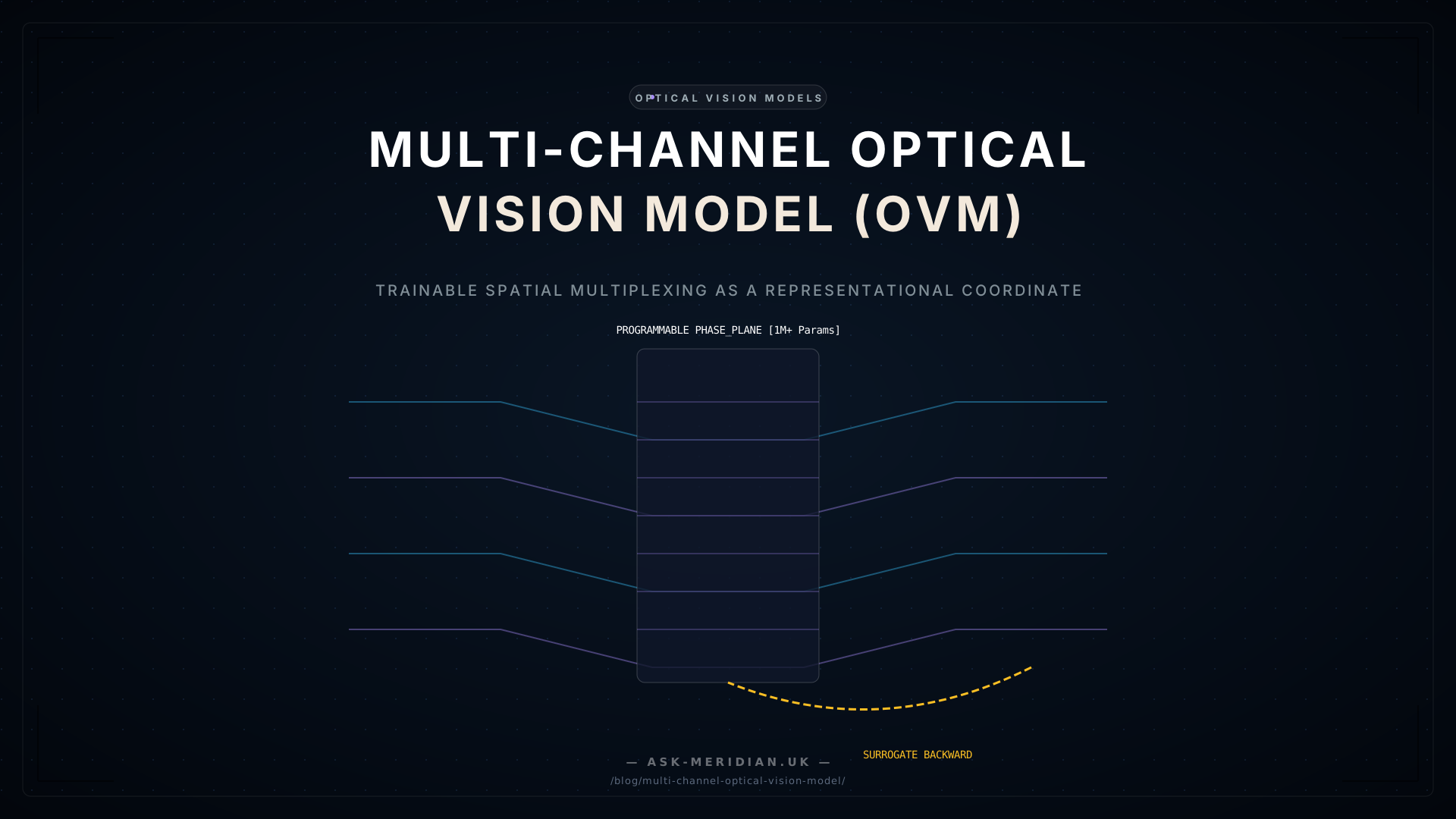
Optical Neural Networks (ONNs) have historically excelled at fixed-function, high-speed linear operations. However, scaling them to the complexity of modern vision and language models has remained a challenge. In the recent paper "Multi-channel Optical Vision Model" (arXiv:2606.10253), Ali Momeni et al. present a paradigm shift: treating spatial channels not just as parallel pipes, but as a rich, trainable readout space.
By leveraging a programmable free-space optical processor with over one million trainable parameters, the researchers demonstrate a multi-layer architecture capable of handling tasks ranging from image classification to controlled image-captioning.
The representational power of spatial channels
The core methodology involves mapping the representation space onto $N$ spatially multiplexed channels. Instead of using these channels for redundant computation, the model treats them as independent learners and structured code dimensions.
Surrogate-Backward Training
Training a physical optical system with over a million parameters requires a sophisticated approach to gradient estimation. The authors employ an online physical-forward / surrogate-backward scheme.
- Physical Forward Pass: Input data is encoded into the optical field and propagated through the physical phase modulators.
- Surrogate Estimation: A differentiable surrogate model estimates the gradient $\nabla_\phi \mathcal{L}$ of the loss with respect to the optical phases.
- Fine-Tuning: The surrogate model is continually updated during training to match the experimental measurements, ensuring high-fidelity optimization.
Hybrid ONN-Transformer Integration
One of the most impressive findings is the integration of the ONN with a digital transformer decoder. The optical processor acts as a "visual encoder," providing high-dimensional tokens that are fed into the transformer for image-captioning tasks.
This hybrid design exploits the low-latency, high-bandwidth nature of optics for front-end feature extraction while utilizing the sequential reasoning capabilities of digital silicon for the language generation phase.
Mathematical Implications
The transition of optical channels into a representational coordinate system can be viewed as an expansion of the network's latent space capacity:
Where $W_k$ represents the optimized phase mask for the $k$-th spatial channel. By increasing the number of trainable channels $N$ and parameters per channel, the OVM achieves a representational density previously reserved for all-digital deep learning models.
Conclusion
The Multi-channel Optical Vision Model provides a blueprint for truly scalable optical computing. By moving beyond SISO/SIMO constraints and embracing spatial multiplexing as a fundamental learnable coordinate, this work paves the way for optical co-processors that can handle the sheer parameter count and architectural diversity of next-generation AI.