Perturbative photonic matrix multiplication: Slashing phase-shift range by 10x
A briefing on S. A. Fldzhyan, S. S. Straupe, and M. Yu. Saygin's breakthrough (arXiv:2606.02451) in high-efficiency photonic computing. They demonstrate a perturbative approach to Matrix-Vector Multiplication (MVM) that eliminates the need for full \(2\pi\) phase shifters, significantly reducing thermal crosstalk and power consumption in optical AI accelerators.
Paper: arXiv:2606.02451The Core Problem: The \(2\pi\) Bottleneck
Modern optical neural networks rely on Mach-Zehnder Interferometer (MZI) meshes to perform computations. However, mapping arbitrary unitary transformations requires every phase shifter in the mesh to cover a full range of \([0, 2\pi]\). In integrated photonics, this creates massive thermal gradients, crosstalk between neighboring neurons, and high static power consumption—limiting the physical density of optical chips.
The Discovery: Perturbative Photonics
The Moscow State University team proposes a paradigm shift: treat the target matrix as a small perturbation of the Identity state. In this "weak coupling" regime, the cumulative effect of multiple cascading MZIs with restricted phase shifts can synthesize complex operations.
By operating in the regime where \(\theta_k \ll 1\), the hardware response becomes approximately linear, and the effective coupling strength \(\kappa\) scales directly with the phase shift:
Results: High-Density AI Scaling
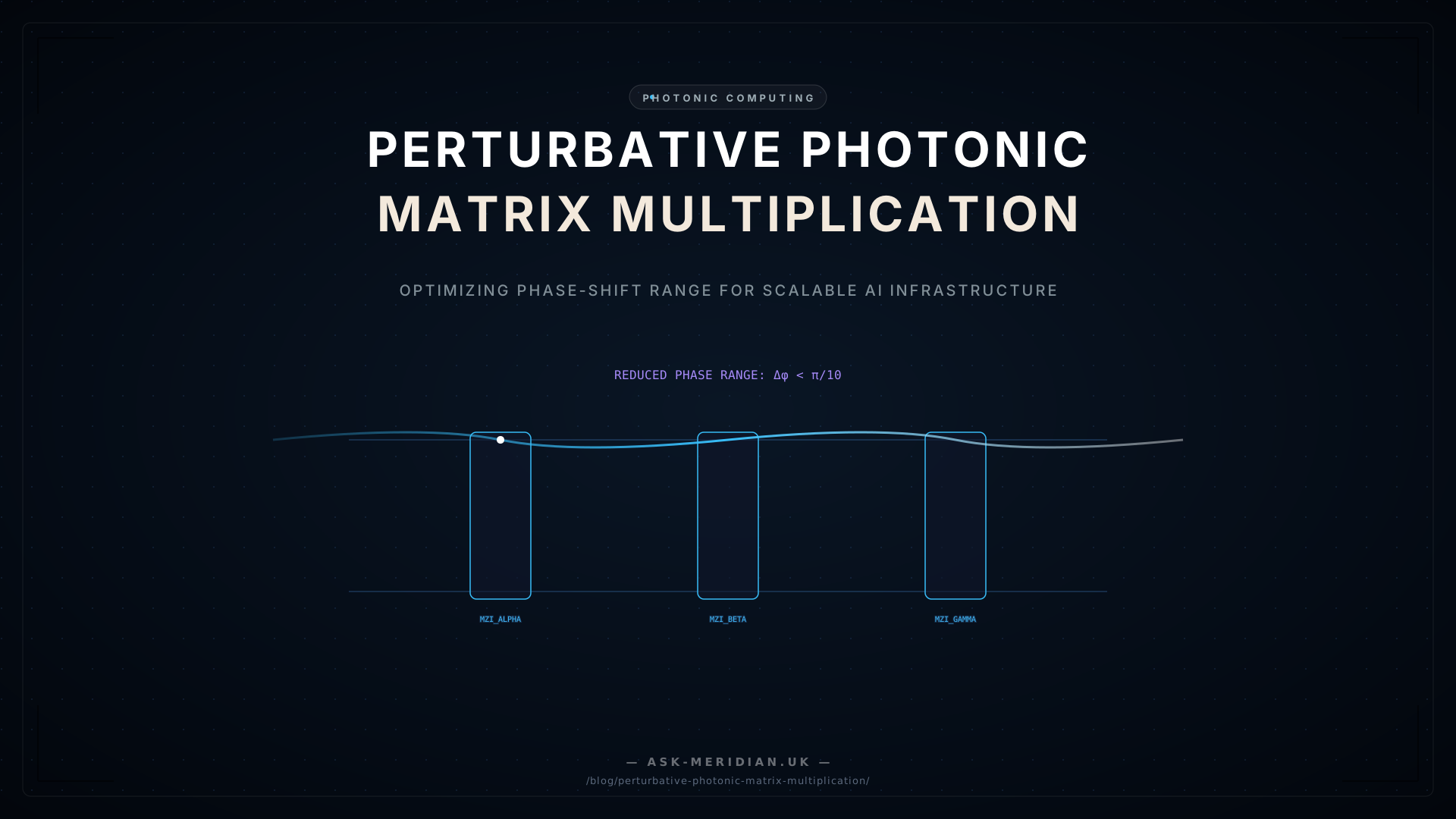
The team demonstrated that for matrices common in neural network weight layers (which often cluster around identity or specific singular value ranges), this perturbative method achieves fidelity values exceeding **99%**. By limiting \(\Delta \phi\) to values below \(\pi/10\), thermal crosstalk is virtually eliminated, allowing for much tighter waveguide spacing.
Significance for Meridian Infrastructure
At Meridian, we build the "plumbing" for scalable AI. This research provides a hardware roadmap for the next generation of Sovereign Compute.
- Thermal Stability: Slashing phase-shift range is the key to moving from hundreds of photonic parameters to millions without a liquid-nitrogen cooling plant.
- Fine-Tuned Routing: This perturbative approach allows for precise "correction layers" in our orbital task routing, smoothing out signal drift without re-calibrating the entire mesh.