Scaling-optimal purification of noisy qubit unitary channels
High-fidelity quantum gates are the bottleneck for scalable quantum AI. A new theoretical breakthrough (arXiv:2606.12394) establishes a parallel protocol that achieves asymptotically optimal $O(1/n)$ noise suppression.
Paper: arXiv:2606.12394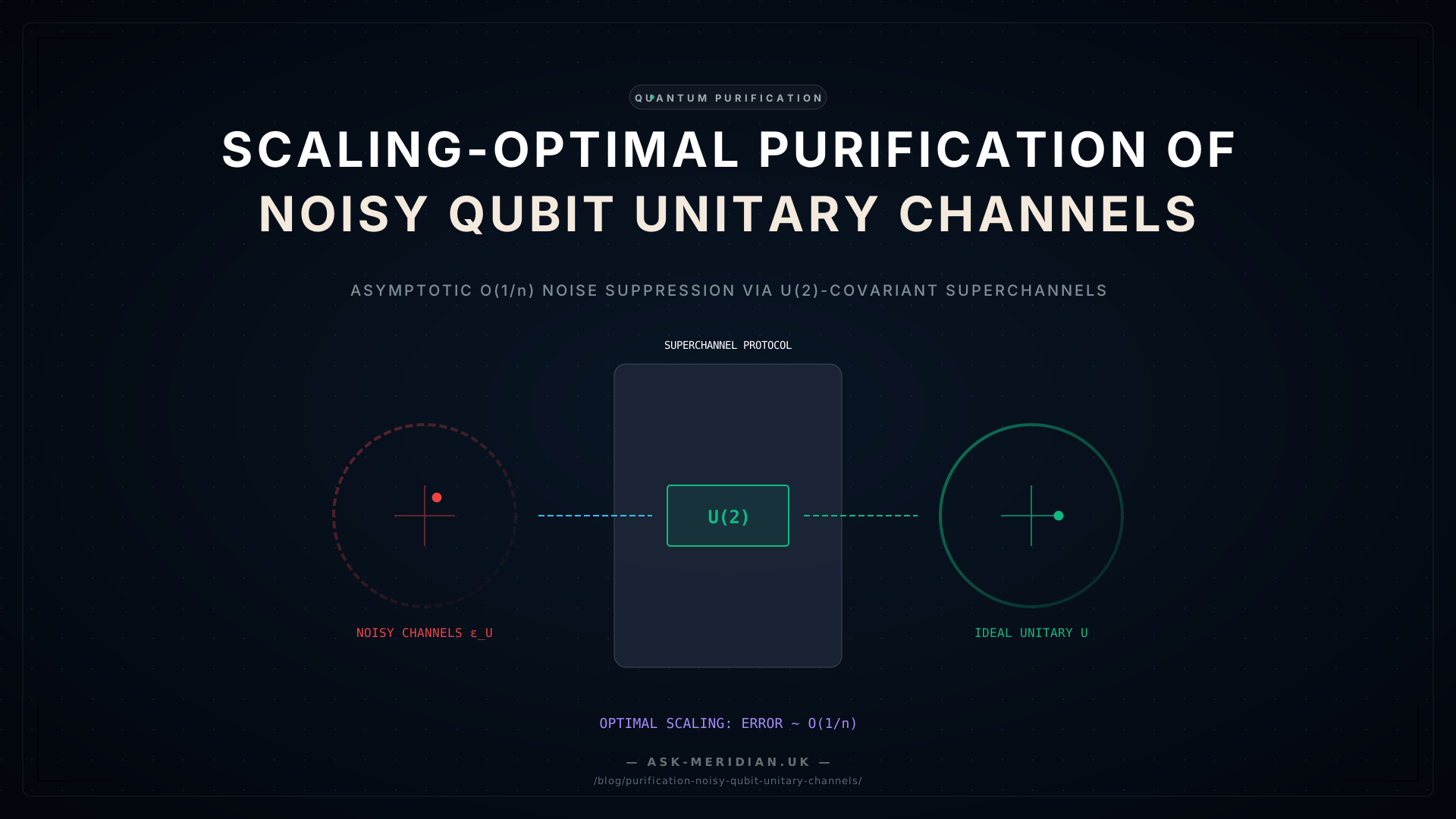
In the Noisy Intermediate-Scale Quantum (NISQ) era, the primary challenge for both quantum neural networks and photonic quantum processors is decoherence. Specifically, when we implement a unitary operation $U$, the actual physical channel $\mathcal{E}_U$ is inevitably affected by noise.
The recent paper "Scaling-optimal purification of noisy qubit unitary channels" (arXiv:2606.12394) by Ryotaro Niwa et al. addresses a fundamental question: if we are given $n$ uses of a noisy channel, what is the best way to transform them back into the ideal unitary $U$?
The Noisy Channel Model
The authors focus on the depolarizing channel, a standard model for quantum noise where the ideal operation is mixed with a maximally mixed state:
Where $p$ is the noise parameter. The goal of channel purification is to use a "superchannel" $\mathcal{S}$—a higher-order quantum operation—to map $n$ noisy instances $\mathcal{E}_U^{\otimes n}$ to an output channel that is as close to $U$ as possible.
Sequential vs. Parallel Strategies
A key contribution of the paper is the rigorous comparison between sequential and parallel strategies. In state purification, parallel strategies are often sufficient. However, for channels, the authors prove a surprising result:
Despite this, sequential strategies are hardware-intensive, requiring long coherence times. To solve this, the authors propose a novel **$U(2)$-covariant parallel protocol**.
The $U(2)$-Covariant Parallel Protocol
By utilizing a specialized entanglement-assisted quantum error-correcting code, the proposed protocol achieves the theoretical limit of noise suppression. The error, measured by the diamond norm distance $\diamond$, scales as:
This $O(1/n)$ scaling is asymptotically optimal, matching the performance of the best possible sequential strategies in the large-$n$ limit.
Implications for Quantum AI
For the development of reliable quantum co-processors, these results provide a critical roadmap. By knowing the optimal scaling bounds, we can design quantum gates that are robust enough for complex deep learning tasks.
The transition from heuristic error mitigation to scaling-optimal superchannels marks a significant step toward predictable, engineering-first quantum architectures.
Conclusion
The work of Niwa et al. establishes the absolute "speed limit" for gate purification. Whether implemented in superconducting circuits or silicon photonics, this $O(1/n)$ protocol ensures that we are extracting the maximum possible fidelity from our noisy quantum resources.