Quantum optics of chiral and antichiral waveguide arrays
A briefing on Peng Wang, Erik Orvehed Hiltunen, and John C. Schotland's arXiv:2605.29536 paper. The work studies single-photon scattering by atoms embedded in arrays of one-way waveguides, and shows why simply changing the alignment of those waveguides changes the mathematics of transport.
Paper: arXiv:2605.29536The Core Problem: Directionality Changes the Physics
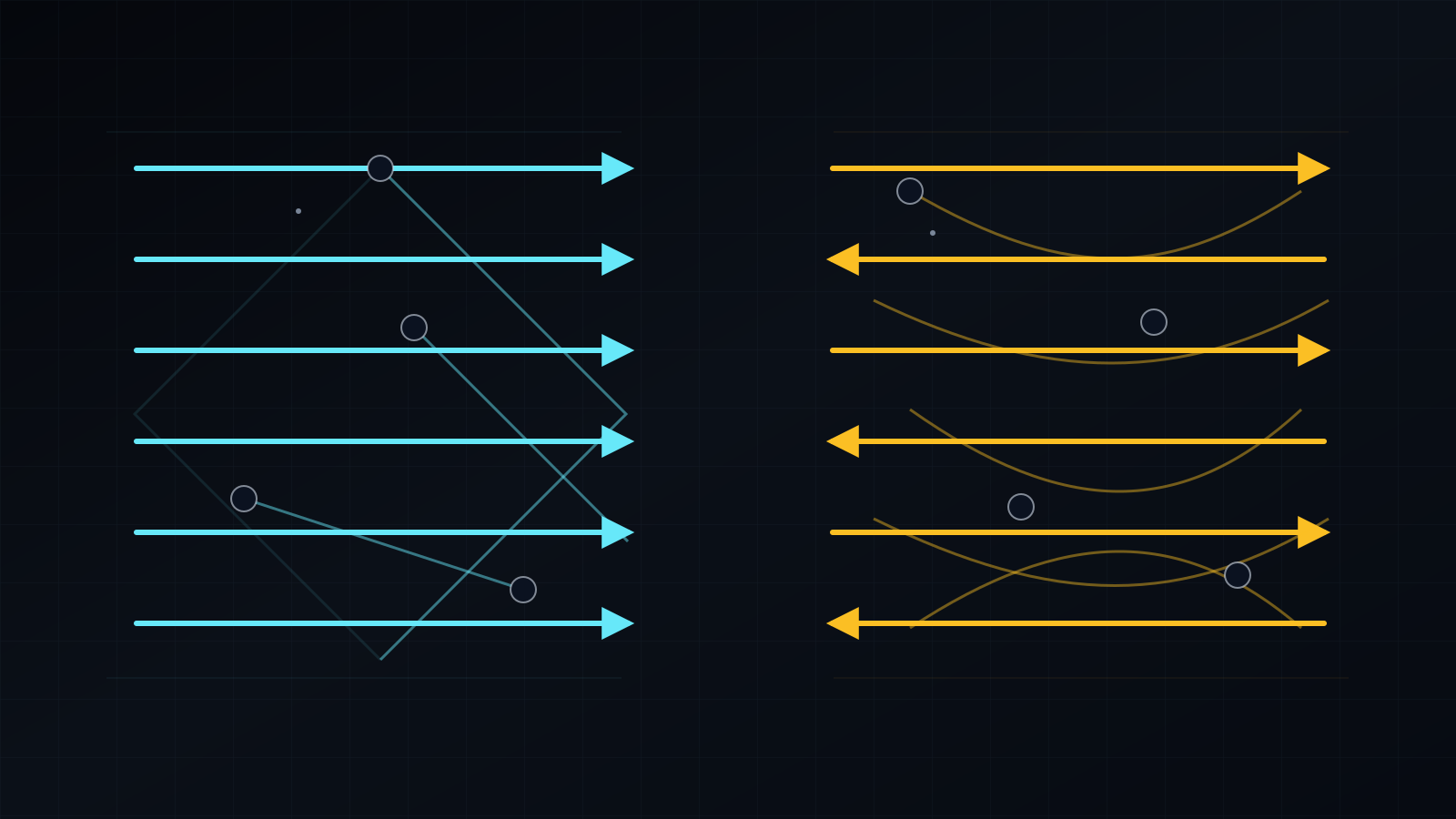
The paper starts from a deceptively small architectural choice. Build an array of one-way waveguides and load the guides with two-level atoms. If every guide points the same way, the authors call the geometry chiral. If neighboring guides point in opposite directions, the geometry is antichiral. The atoms are not decoration; their density becomes an effective potential for the single-photon amplitude.
That alignment choice decides whether the continuum model behaves like a space-time propagation problem or an ordinary spatial scattering problem. In other words, the same physical ingredients produce two different optical calculi.
Chiral Arrays: A Time-Like Coordinate
In the chiral array, the coordinate along the waveguide becomes time-like in the effective Dirac equation. The transverse coordinate remains space-like, and the frequency offset between alternating subarrays behaves like a mass term. The result is a hyperbolic transport problem: signals have domains of influence, singularities propagate, and scattering creates light-cone structures rather than smooth all-direction interference.
This is the part that makes the paper operationally interesting. A scatterer in the chiral array does not behave like a tiny lens in a passive plane. It behaves more like a localized event inside a propagation geometry: the downstream field sees a cone of influence and the absence of ordinary backscattering along the time-like direction.
Antichiral Arrays: Classical Optics Reappears
In the antichiral array, neighboring guides have opposite group velocities. The effective equation becomes a two-dimensional spatial Dirac problem: both coordinates are space-like, and the PDE is elliptic. That shift restores a scattering theory that looks much closer to classical physical optics. Fields smooth out, interference is global, and rotational symmetry allows the authors to compute circular-scatterer analogs of two-dimensional Mie scattering.
Three Regimes, One Comparison
The authors do not stop at the continuum equation. They work through three regimes that make the chiral/antichiral split concrete:
- Geometrical optics: slowly varying atomic density leads to eikonal and transport equations. Rays in the chiral array reflect the time-like direction; rays in the antichiral array bend like classical optical rays.
- Diffraction: single-slit propagation produces different kernels. The chiral case carries light-cone behavior, while the antichiral case looks like ordinary wave diffraction.
- Scattering: point scatterers, multiple scatterers, circular obstacles, and slabs expose the same contrast. Chiral scattering remains causally constrained; antichiral scattering supports reflection, transmission, and smooth interference.
Why It Matters for Photonic Routing
For Meridian, the relevant lesson is not a product claim; it is an architectural one. Routing is not only about selecting a path through a graph. In physical photonic systems, the direction and symmetry of the substrate determine what kinds of scattering, latency, and feedback are even possible. The chiral array behaves like a transport surface with a built-in arrow of propagation. The antichiral array behaves more like a spatial medium where conventional interference and boundary-value thinking apply.
That distinction is useful when thinking about agent infrastructure by analogy: some systems should be modeled as downstream execution pipelines with limited upstream influence, while others should be modeled as spatial coordination fields where every obstacle can reshape the global solution.
What the Paper Does Not Claim
This is a theoretical and numerical study of single-photon scattering in one-way waveguide arrays. It is not an experimental demonstration, not an altermagnetic photonic crystal paper, and not a claim about pseudospin filtering. Its value is the clean mathematical separation between two waveguide-array geometries and the optical regimes each geometry supports.